

US Energy Independence

Some of my friends claim the US attacked Venezuela and Iran because we need their oil. I think it is the opposite - the US went after Venezuela and Iran just because we have no need for their oil
The US is now free to go after these bullies just because it doesn’t need their oil. It is energy independent. It does not need their oil - it has more than enough for its own use. Instead, it is acting from a position of strength. Here is a good reference for possible strategic responses to the Iran crisis by various countries.
I believe the US is taking the opportunity to address problems before they become too big to handle. “Problems that are left unattended have a habit of becoming crises”, Lord Chief Justice William Gascoigne, adviser to King Henry V, 1410s, in the movie “The King”, before Henry would direct some attention to France.
Energy Independence vs Energy Affordability
As always with these interesting claims, I nerded out, let myself get sucked into the vortex of global energy consumption and production, and probably got in too deep.
It is not uncommon to confuse energy independence with guaranteed low energy prices. While the US has enough energy to serve its own demand, WTI prices have been dependent on what happens at the world stage. This is because, since the lift of a US export ban in 2015, the US is allowed to export crude oil. It is part of a system of open markets. That means that if someone in Europe fancies to pay $200 for a barrel of Permian Basin crude, it will travel to the port of Rotterdam instead of a Gulf Coast refinery, thus raising the price of a US barrel.
Energy security means that you can access that barrel because it is on a secure path to you, probably close to you, where the possibility of disruption of delivery is minimal or absent. It is not impacted by hurricanes, a canal closure, a vessel shortage, borders, bowing up of pipelines, embargoes or Iranian terrorists.
You still pay the price of the open world market - unless the government bans exports again. And, while the overall price of that barrel may be higher, it does rise to include the risk premium that other are required to pay for the extra time to delivery, for border tariffs, transportation and storage cost.
For natural gas, where LNG transportation is still a bottleneck, the rest of the world has not benefitted from the price reduction enjoyed by North Americans. Today, most of the world pays 5x more for a million British thermal units (MMBtu) of natural gas energy, and it was even more for Europeans in 2022 due to pipeline delivery disruptions from Russia. Clearly, dependency has its price.
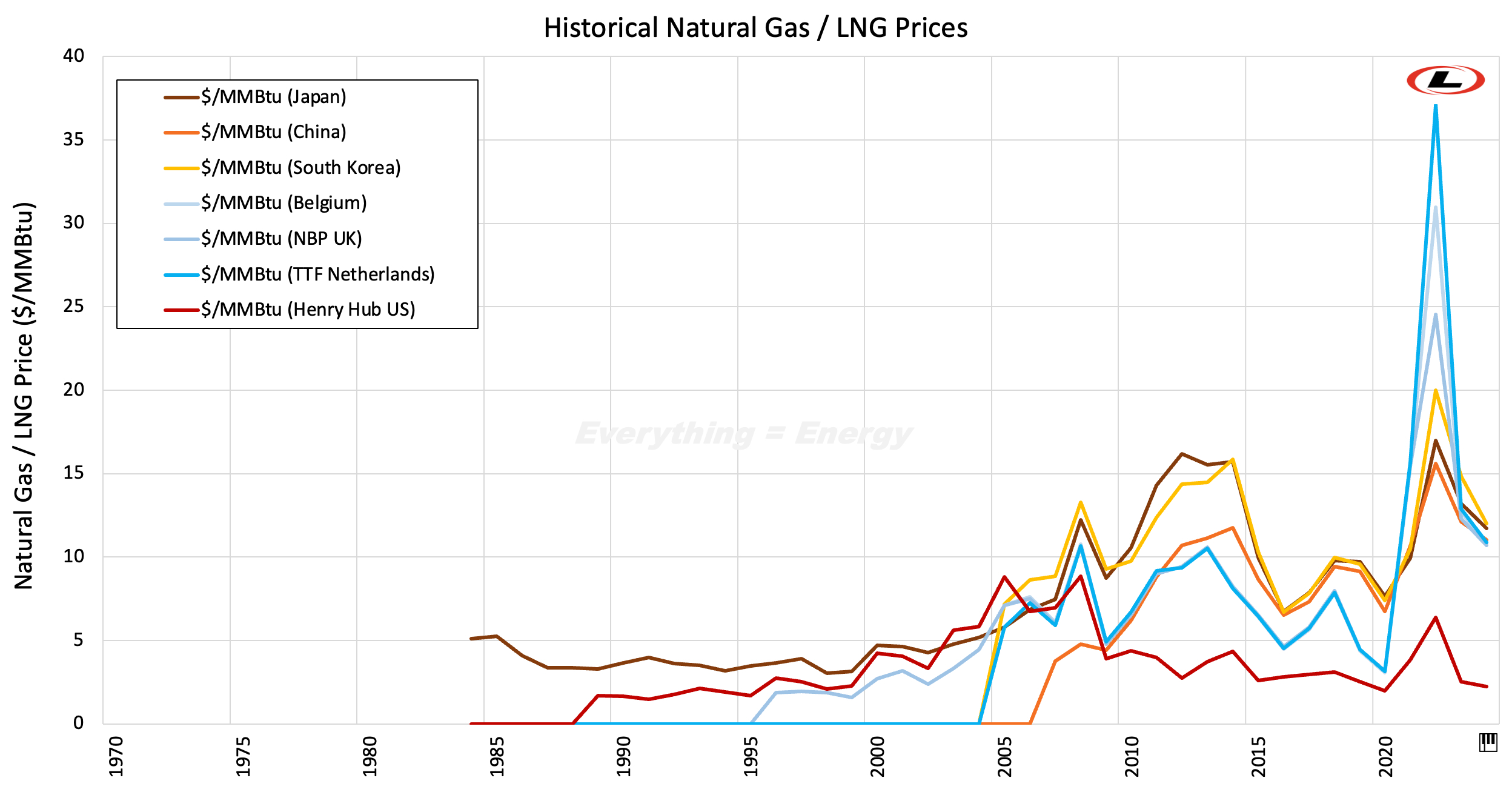
Figure 1: Natural gas prices around the world. Can you spot the independent?
Inequality in Energy
Before we dive into the details of US energy production dominance, let’s look at the overall distribution of energy.
The Energy Institute’s yearly data and report (formerly BP’s Statistical Review) divides the world in seven geopolitical regions, aiming to combine statistical results for countries that behave more alike than the usual continental divisions.
Figure 2 shows that almost half of the world’s 640 EJ primary energy consumption is in the Asia Pacific region - because that’s where more than half of the world’s population is located. For most of their energy they depend on coal, the workhorse for cheap energy poverty alleviation.
Population distribution is the key to understand that energy flows mostly towards this massive region. Average per capita energy consumption in the Asia Pacific region is about the world average, meaning that it requires an energy share that is in proportion to its population share.
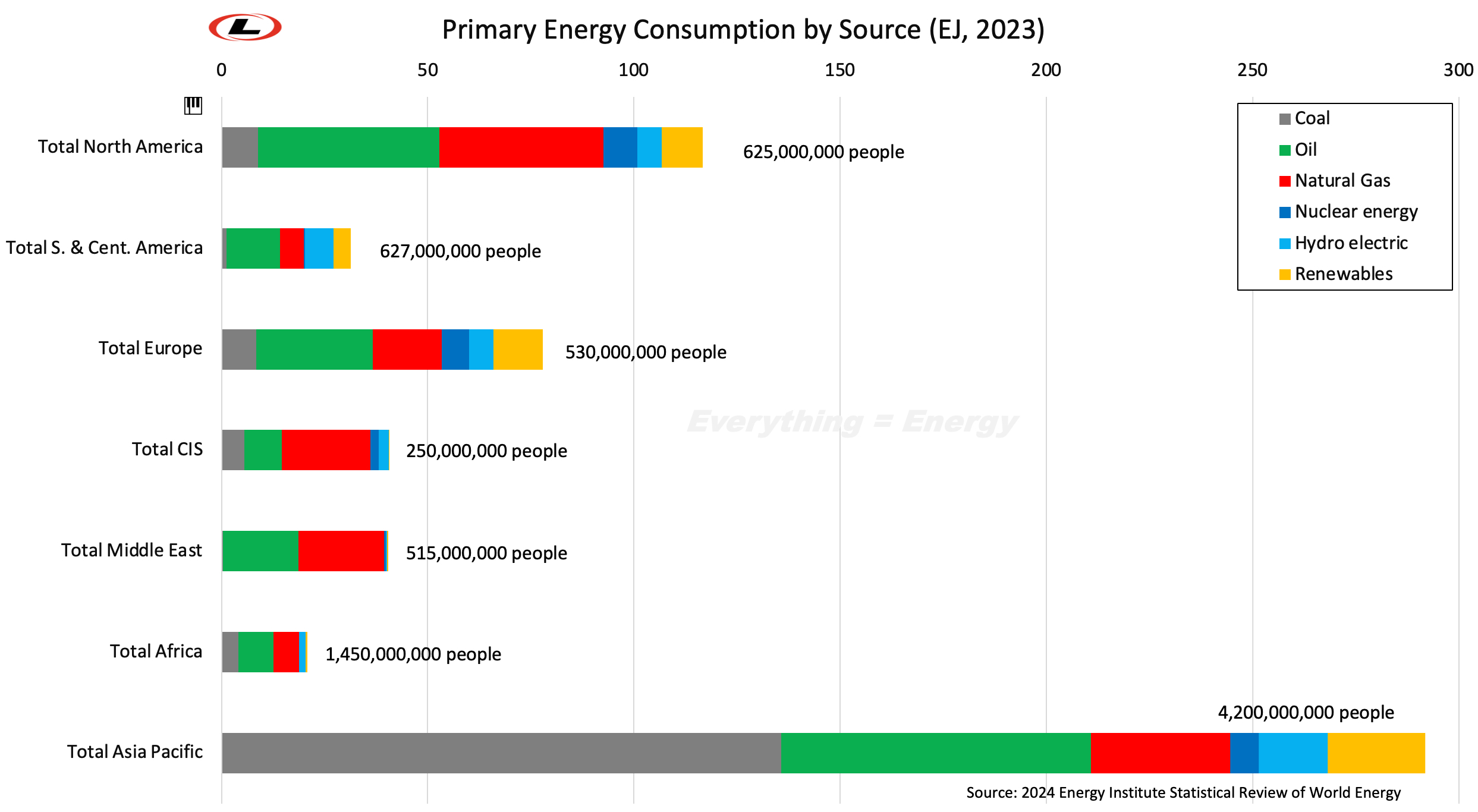
Figure 2: Energy consumption by region
If you care about equality between people this should be an area to pay attention to - there are many people in the world who get a lot less than you, my dear reader. Take a look at the smallest bar in Figure 2, Africa. It uses about 3% of the world’s energy while 18% of the world’s population lives there. North America, on the other hand, has 8% of the world’s population and consumes about 19%. Between these two regional extremes lies a 17x per capita energy consumption differential.
Let’s plot total primary energy consumption by country, but sorted by these seven regions. As shown on the right of Figure 3, the per capita average is 77 GJ/person/year, or the equivalent of 1.5 gallons of gasoline per person per day. OECD-country use is about 2.5x that of non-OECD use.
The Middle East has a few countries with the highest per capita use, mostly because of abundant and cheap government-subsidized oil. CIS, the Commonwealth of Independent States or former Soviet republics, and northern North America are also significant energy consumers. As a region, Europe’s per capital energy consumption sits in the middle due to a significant per capital energy reduction, mostly associated with outsourcing of manufacturing.
At least partially due to that, Asia Pacific is in the rise, and as a region (right black-lined column for each region) very close to the per capita world average. This is the region with the biggest extremes, between ultra-advanced cities like Singapore and countries in very early development such as Bangladesh.
Africa per capita energy consumption is by far the lowest, and mostly below the 50 GJ per person per year minimum that the IEA has set, and in dire need of more energy to improve quality of life and life expectancy.
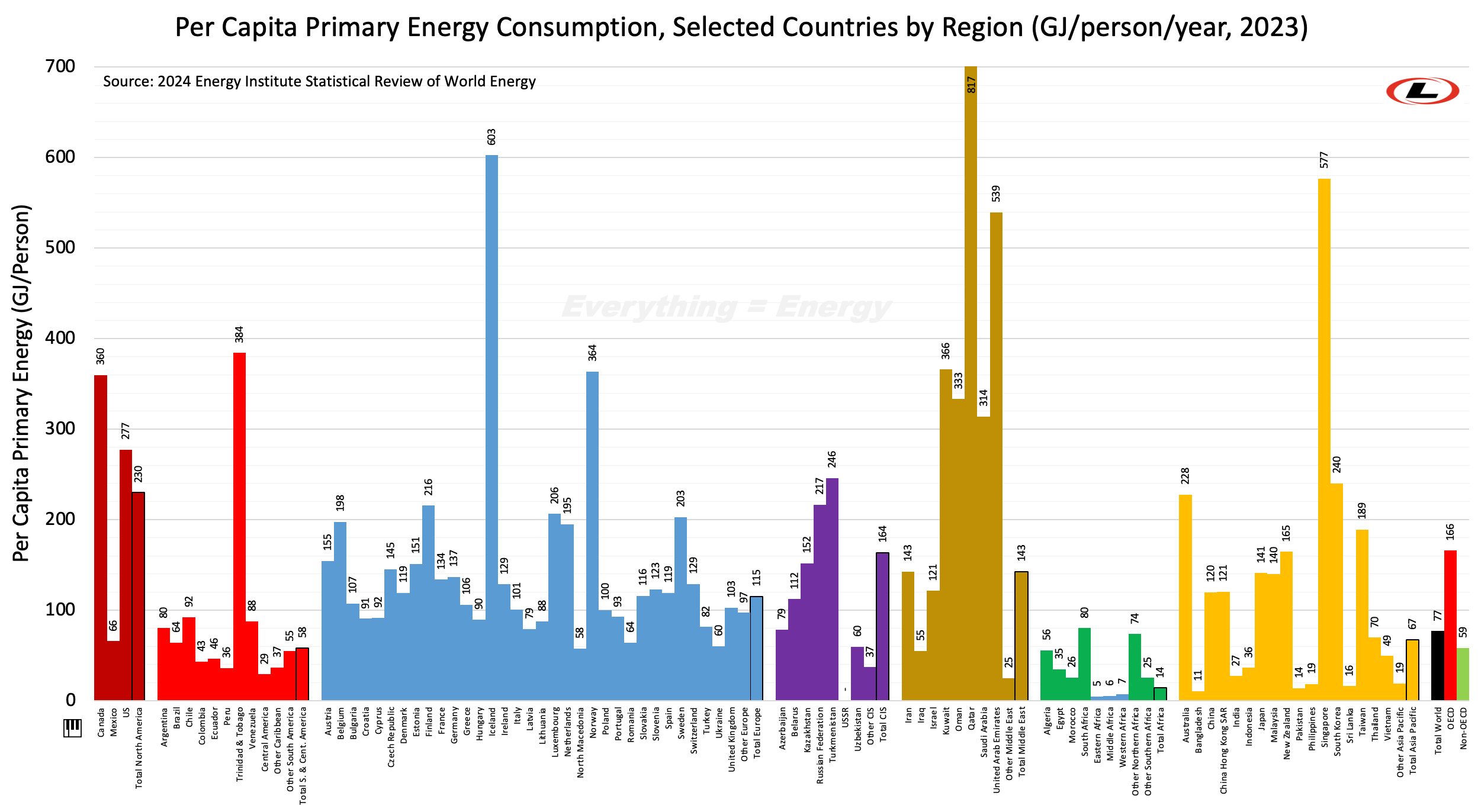
Figure 3: Per capita energy consumption by region
To get an idea of the biggest players in energy, Figure 4 shows the top 10 of primary energy consumers. These 10 countries represent half of the world population and two-thirds of world primary energy consumption.
China is by far the biggest consumer with about 26% of the total. More than half of China’s energy comes from coal, a secure domestic source of energy. This is what powers its manufacturing sector, including manufacturing of so-called renewable wind and solar power source components. Counter to popular belief, China does not run on renewables, but it does have significant amongst the biggest domestic contributions from hydro-electricity, wind and solar.
US primary power sources are mostly oil and gas, and it has a good mix of other power sources as well. Like China, India, a country in development, runs mostly on coal. Based on its low per capita use, it is hard to think the world is at peak coal consumption, as some forecasters believe.
A few members of the group represent OPEC+: Russia, Iran and Saudi Arabia. Their economies run almost exclusively on oil and gas. While Brazil is a big oil producer, it is rich in hydro-electric power from the Amazon river and it also gets a significant energy contribution from subsidized sugarcane-derived ethanol.
South Korea has recently risen past the post-WWII miracle of Japan and Germany, and is a great example for some of the Far Eastern tiger economies like Malaysia, Indonesia, and Vietnam.
Germany, as the only remaining European representative, is hanging on by a tread and will soon disappear from this list of world top energy consumers. Despite its government-driven favoritism of renewables, fossil fuels are used for three-quarters of its energy needs.
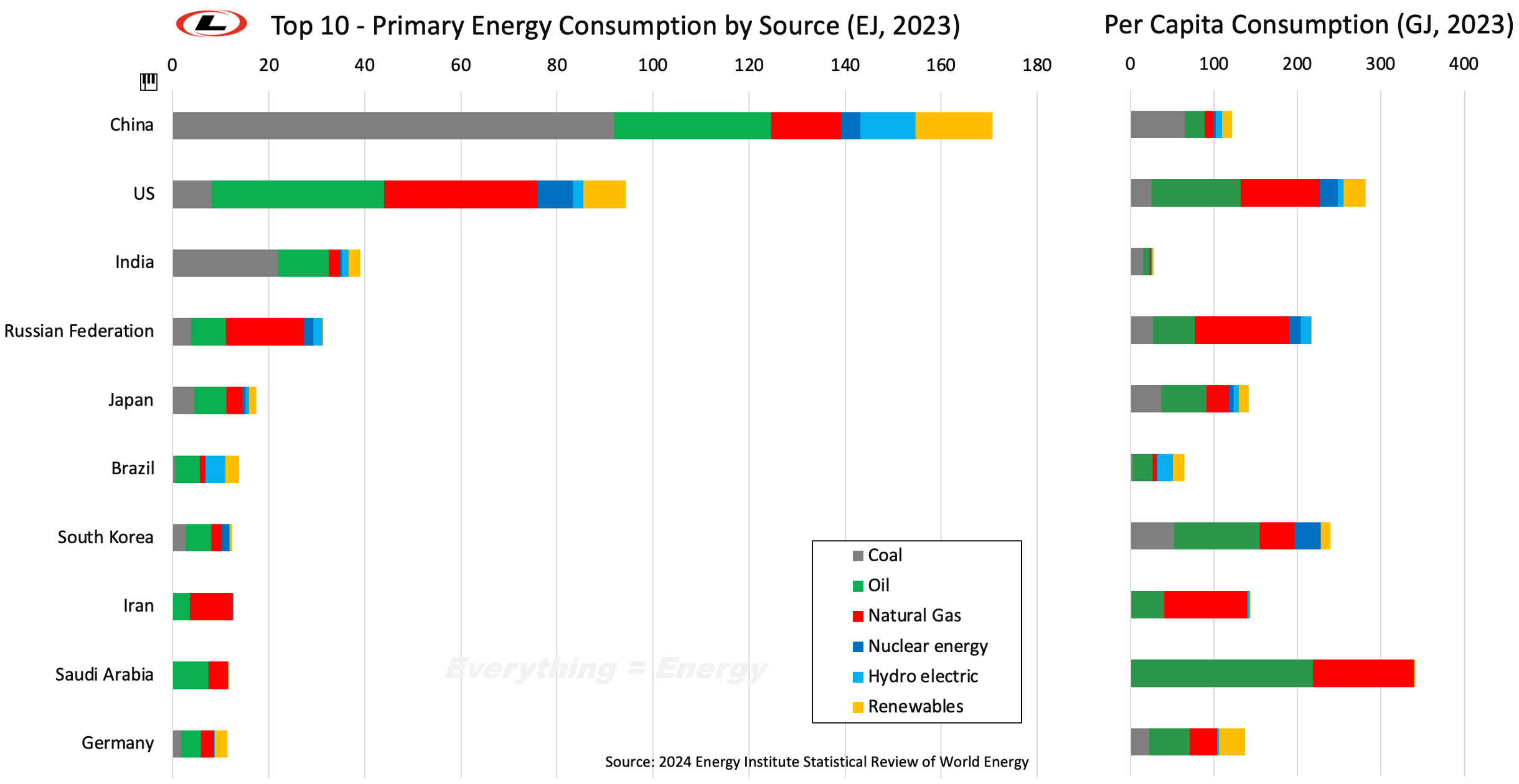
Figure 4: Top 10 world energy consumers, including their respective per capita consumption.
Energy Independence
There are a few definitions for energy (in)dependence:
“Net Energy Import Dependence Rate%” = Net Imports / (Gross Consumption+Bunkers)
“Energy Self-Sufficiency Ratio” = Total Primary Energy Production / Total Primary Energy Consumption
“Energy Independence”: Net Exports = Total Production - Total Consumption
In Figure 5 below, we use the first definition. Exporters and importers are ranked from left to right by percent import as compared to their domestic consumption.
There are about 40 countries out of a total of ~200, depending on how you count, that are net energy exporters. Amongst them are resource-rich western countries that are not overwhelmed by nimbyism to develop their own energy resources - Norway, Australia, Canada and the USA. There are a few oil-rich countries part of OPEC+, and finally a few poor countries who export to others while they probably could have used the resource themselves if they had the capital and infrastructure to support it. Can you believe rich countries import energy from countries such as Equatorial Guinea (exports 422% of domestic use), Angola (254%), the Republic of Congo (347%), Libya (250%), Gabon (188%) and Chad (172%)? While independent on energy, these countries are heavily dependent on the cash from energy sales.
Norway is the biggest exporter in relative terms - it exports 7x more energy than it consumes. It is often called a poster-boy for renewables. It is uniquely blessed: with water and a massive differential altitude, making it ideal for hydro-electricity; with massive offshore oil and gas; and with a tiny population of ~6 million people.
Most countries import energy. In a few rare occasions, on the right side of below graph, their imports are above 100% of domestic consumption - for a few city states, small countries with a large population, and trading nations that bunker oil. This group includes Singapore, Luxembourg and even the Netherlands.
The USA has recently become a net energy exporter. While 6% excess for sport purposes may not sound like a whole lot of lot, remember it is the second biggest energy consumer. And that highlights a shortcoming of this graph.
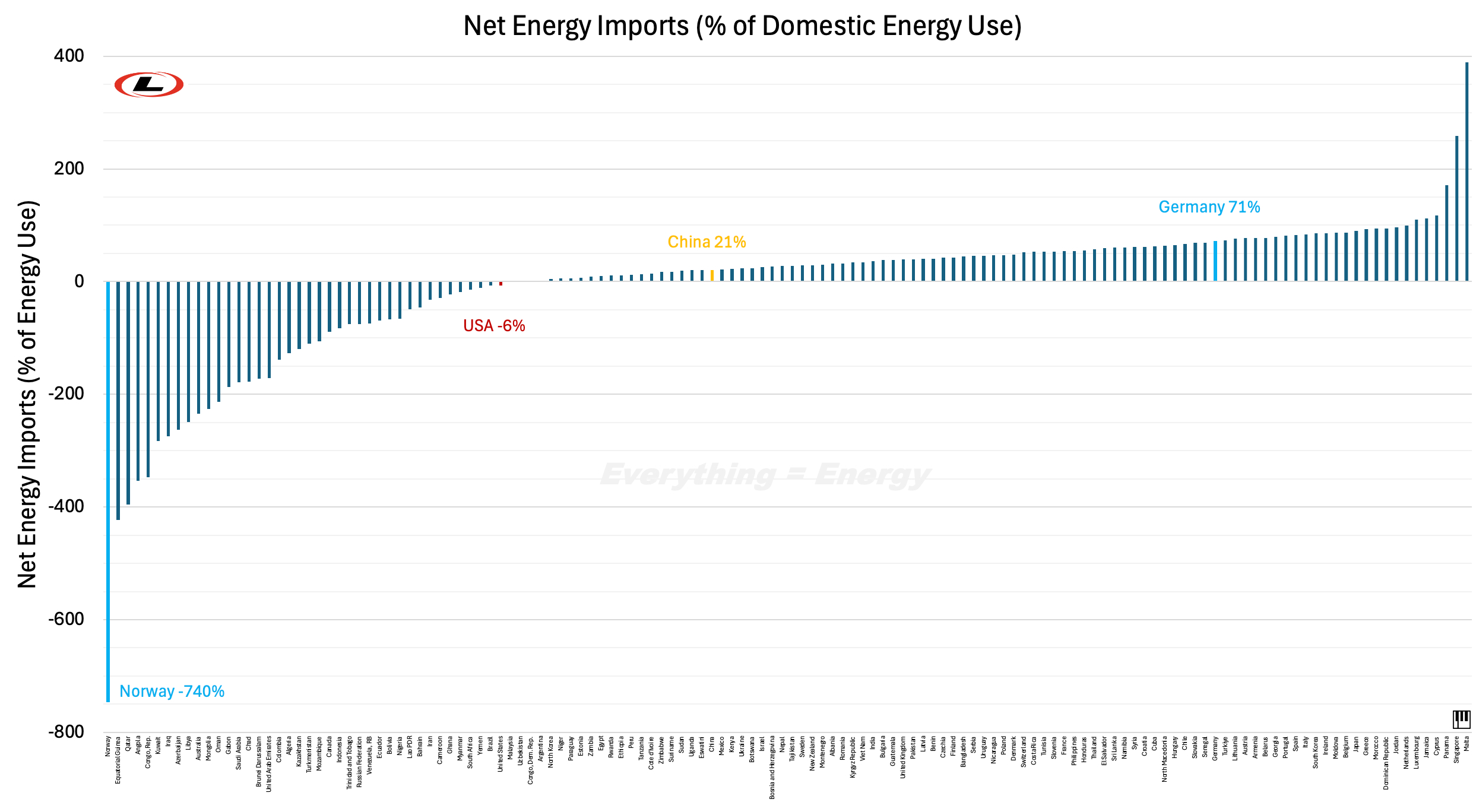
Figure 5: Net imports and exports of ~135 countries, ranked by % of domestic consumption. 70% of these countries are importers.
While it provides a good idea about the domestic relevance of imports and exports, it does not allow an absolute comparison between countries, and an evaluation of the significance of their imports or exports on a world stage. This is addressed in Figure 6 below. For improved visibility, I have only listed the biggest importers and exporters, representing 90% of net energy trades.
Most countries are dependent on energy from others. About 180 EJ changes hands in gross primary energy trade terms, out of 640 EJ primary energy consumed. About a net trade of 135 EJ is represented by the graph.
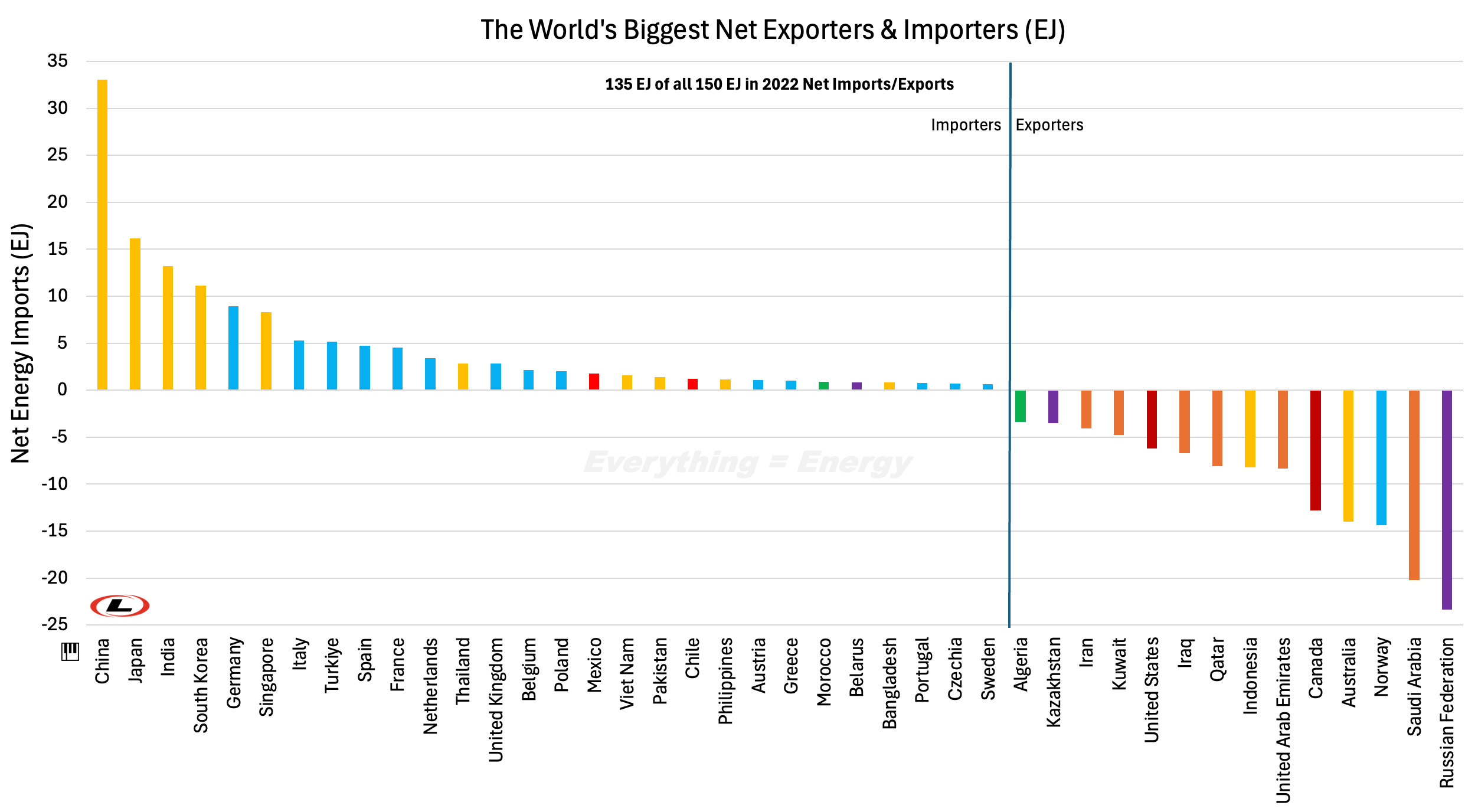
Figure 6: the biggest net importers and net exporters - ranked by absolute value in Primary Energy (in EJ)
90% of net energy exports are provided by 14 countries, essentially the big OPEC producers + Russia (and now also UAE), and a few resource-rich developed countries- Norway, Australia, Canada and the USA. Russia is the biggest exporter with about 23 EJ, mostly in oil and gas. For most of the others, except Australia and Indonesia, their trade is in oil. And for these remaining two countries it is coal, which is much needed in the Asia Pacific region. These 14 countries, and another 27 smaller ones, provide backup for growth and other country’s nimbyism.
On the left hand side are the dependents. Notice the color by region - these dependents are mostly in the Asia Pacific and the Europe regions. China’s 21% imports represent a whopping 33 EJ. Japan, India and South Korea import a similar amount. And Germany imports about 71% of its energy needs.
Mobility is key for imports and exports. Electrons are less mobile across regions than molecules. Almost all of these trades, bar about 3 EJ, are in coal, oil and natural gas. The molecules are mobile - and mostly can be put on a vessel, on a train or stuck in a pipeline. With similar reach, and with bigger oceans unable to be bridged, electrons can be sent through a (subsea) power line.
Note there is another 60 EJ in trade in refined oil products that is not part of this graph, as it only represents primary energy trades.
US Energy Strength
Figure 7 shows the changes in total primary energy production in the United States between 2005 and 2024. This is a waterfall plot that highlights the growth of every individual primary energy source over that time period.
There is a tendency in the mainstream media to talk up the growth in renewable resources, including in the US. Their preferred metric is relative growth compared to itself in the past. For example, solar, wind and other renewable power have grown from 0.5 to 3.1 EJ in the US, a staggering 520% increase in just two decades. However, as shown in Figure 7, this becomes less remarkable when plotted in absolute terms, but the yellow sliver has become quite a bit thicker as a result of $1.5 trillion renewable energy investment in the US.
There are two changes that are an order of magnitude bigger than the change in renewables. First, the Shale Revolution has lifted US production of oil and natural gas to record historic levels. Second, production of coal is down, mostly due to a reduction in domestic coal consumption as a result of competition from cheap natural gas produced from shale.
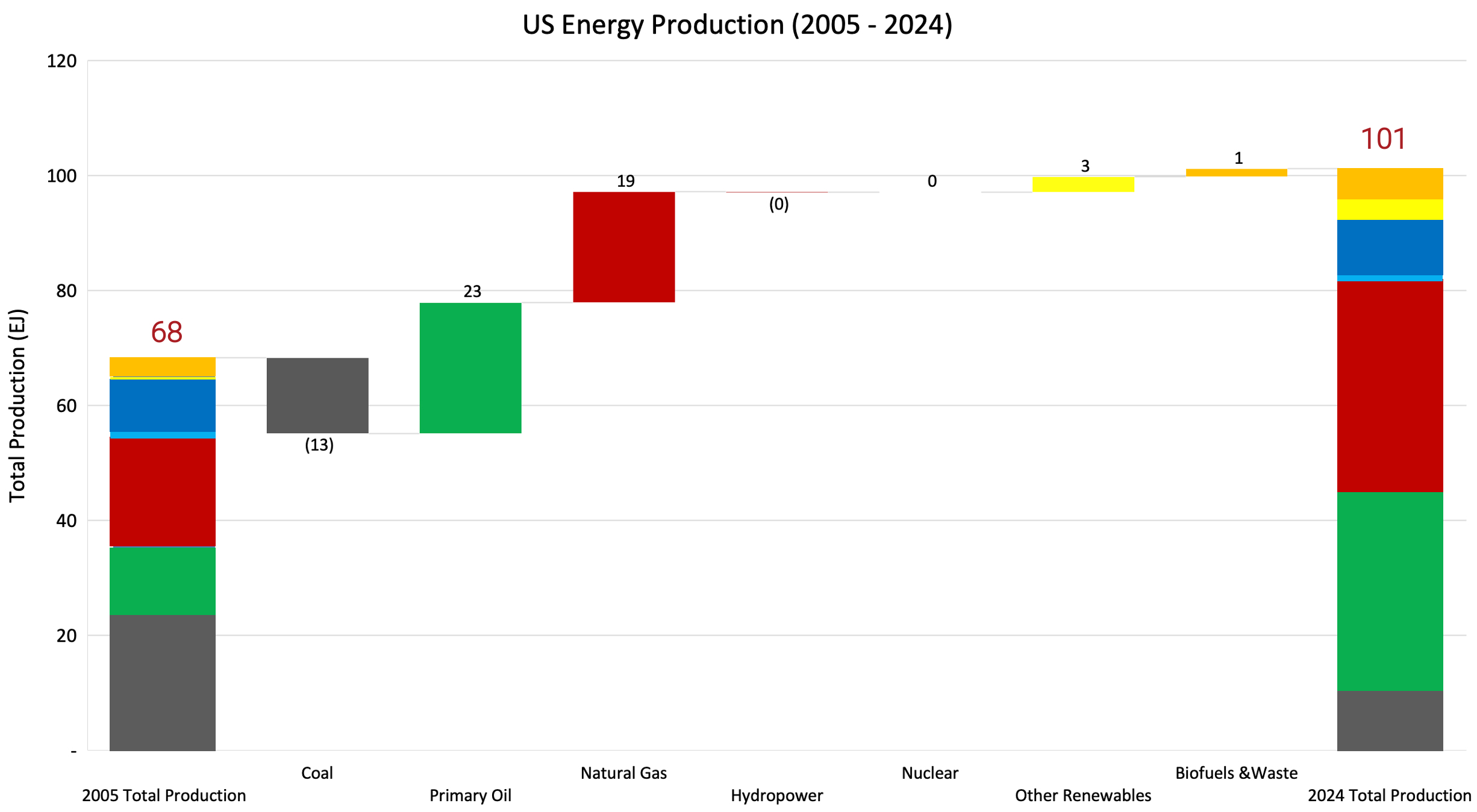
Figure 7: US primary energy production and change between 2005 - 2024. What energy transition?
This increase in US oil and natural gas production have resulted in many changes - amongst these changes to import / export behavior, shown on a yearly basis by source in Figure 8 below. Peak import was in 2005. A slightly different view, but for a little longer from 1950 - 2024.
The US has always been a net coal exporter. Even today, it exports about 2.7 EJ, or about 100 million tons of coal on a yearly basis. Yearly, that’s about 8,000 unit trains with 100 railcars each, or about 22 a day. The US is the world’s #4 coal exporter (after Indonesia, Australia and Russia).
Around 2009, the US started exporting refined oil products. Today, it exports about 7.5 EJ in secondary oil products, while it imports 5.3 EJ in (primary) crude oil, or a net export balance for oil and oil products of ~1 MMbopd, and the US became a net oil exporter in 2022. But excess refining capacity makes the US upgrade oil products, and gain in associated sales, especially when oil prices are higher.
The US has been a net gas exporter since 2018, and has grown fast. Famously, before the Shale Revolution the US build LNG terminals for natural gas imports. As natural gas production soared, these were all converted to LNG export terminals. Today the US is the world’s biggest natural gas exporter, moving almost 5 EJ, or 4.75 Tcf in natural gas to allies around the world. That’s about 13 Bcfd, or about 7 LNG vessels a day. The US is now the #1 natural gas exporter, just ahead of Australia and Qatar.
Overall, the US has been a net energy exporter since 2019. We can blame the Shale Revolution for that transition into a position of strength.
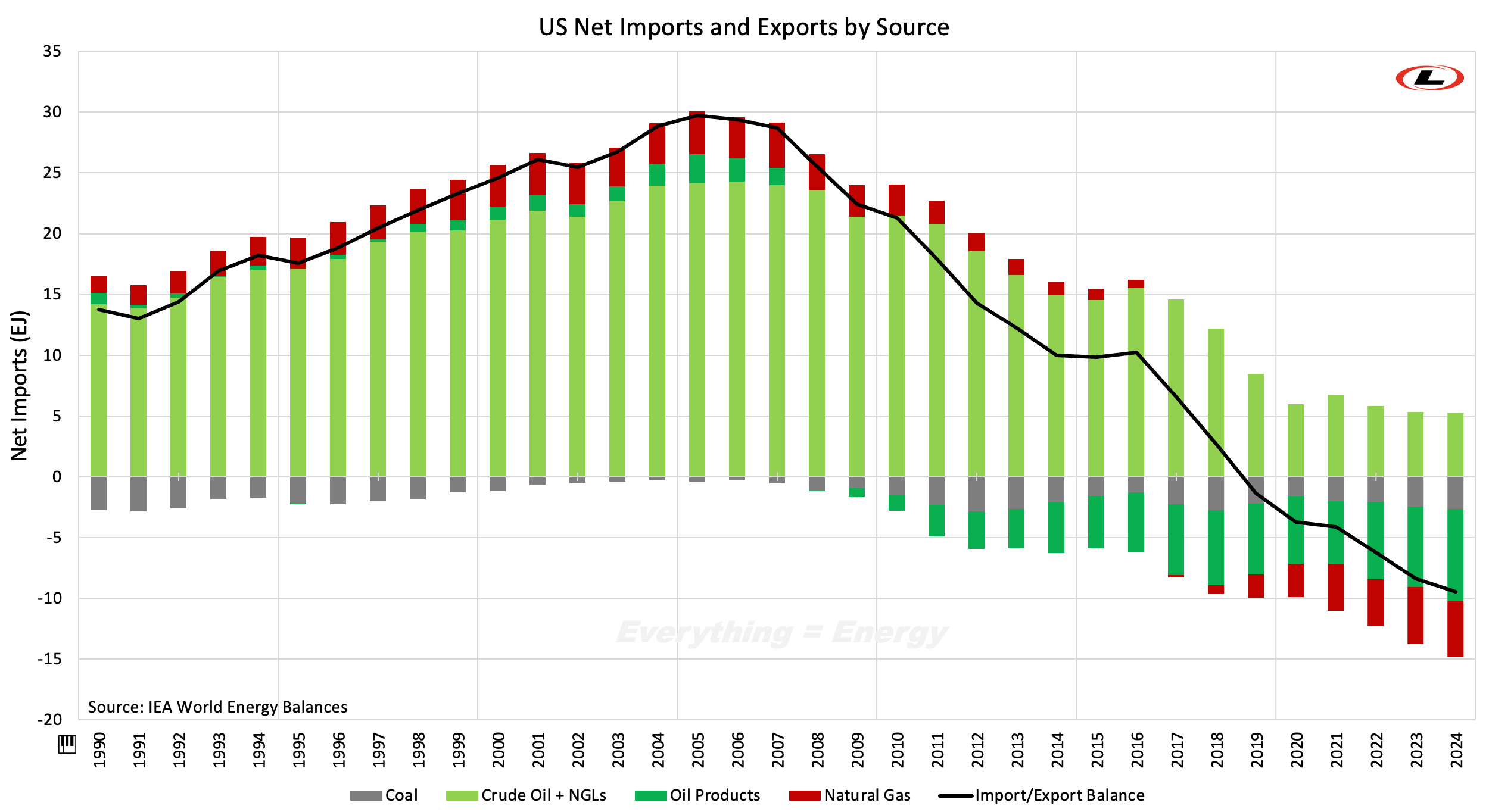
Figure 8: US net imports and exports since 1990.
As pointed out by Doomberg earlier this week

the oil the US imports is mostly from friendly Canada, who doesn’t easily trade with anyone else and who sells heavier crude at a -$16/bbl spread with WTI. Even for the crude that is imported, I would hardly call that dependent.
The only dependency tied to the US is in California. About three tankers a week reach California from South America (Ecuador, Brazil) and the Straight of Hormuz (from Iraq and Saudi Arabia). California has become an energy island because it is a political island.
So, no, I do not think Venezuela and Iran were targeted because the US needs more oil.
Conclusions
Only 14 countries (out of ~200) are responsible for 90% of the world’s net energy exports.
The US is a net exporter of energy. It is the #1 producer of oil, the #1 producer of natural gas, and the #1 exporter of natural gas
Going after bullies who build nuclear bombs, sell drugs or disrupt world trade is easier from a position of energy strength
Nicely explained, thank you.