

LCOE vs LFSCOE

The Levelized Cost of Energy (LCOE) is a favorite cost metric of renewable power pundits because it ignores the cost of intermittency, a feature of weather-dependent power sources. To more properly account for intermittency, some people have introduced the Levelized Full System Cost of Energy (LFSCOE).
Lazard, the standard bearer of LCEO, has long acknowledged it as a flawed metric . But its customers love it! On some of the back pages, they have added the cost for 4 hours of “firming”, but that is not nearly enough when a night lasts 12 hours or a dunkelflaute lasts a week. Even Lazard’s short firming almost doubles solar LCOE for a US solar mix.
In a recent study, Isaac Orr showed that existing 1 MW coal power plants in Minnesota are replaced by 1 MW natural gas, 0.62 MW solar and 1.6 MW wind, meaning a 3.2x power replacement rate. He also shows that for 100% solar, wind and battery backup in Wisconsin, the state would need to build 7.7x its current power capacity in wind, solar and batteries.
Another paper, by Robert Idel, PhD, introduces the concept of LFSCOE-95, or LCOE for a "Full System" catering to 95% of demand. He shows German solar LFSCOE-95 at ~1,500 $/MWh, or about 25x Lazard’s Utility Solar’s average LCOE. How can this increase in cost be so enormous?
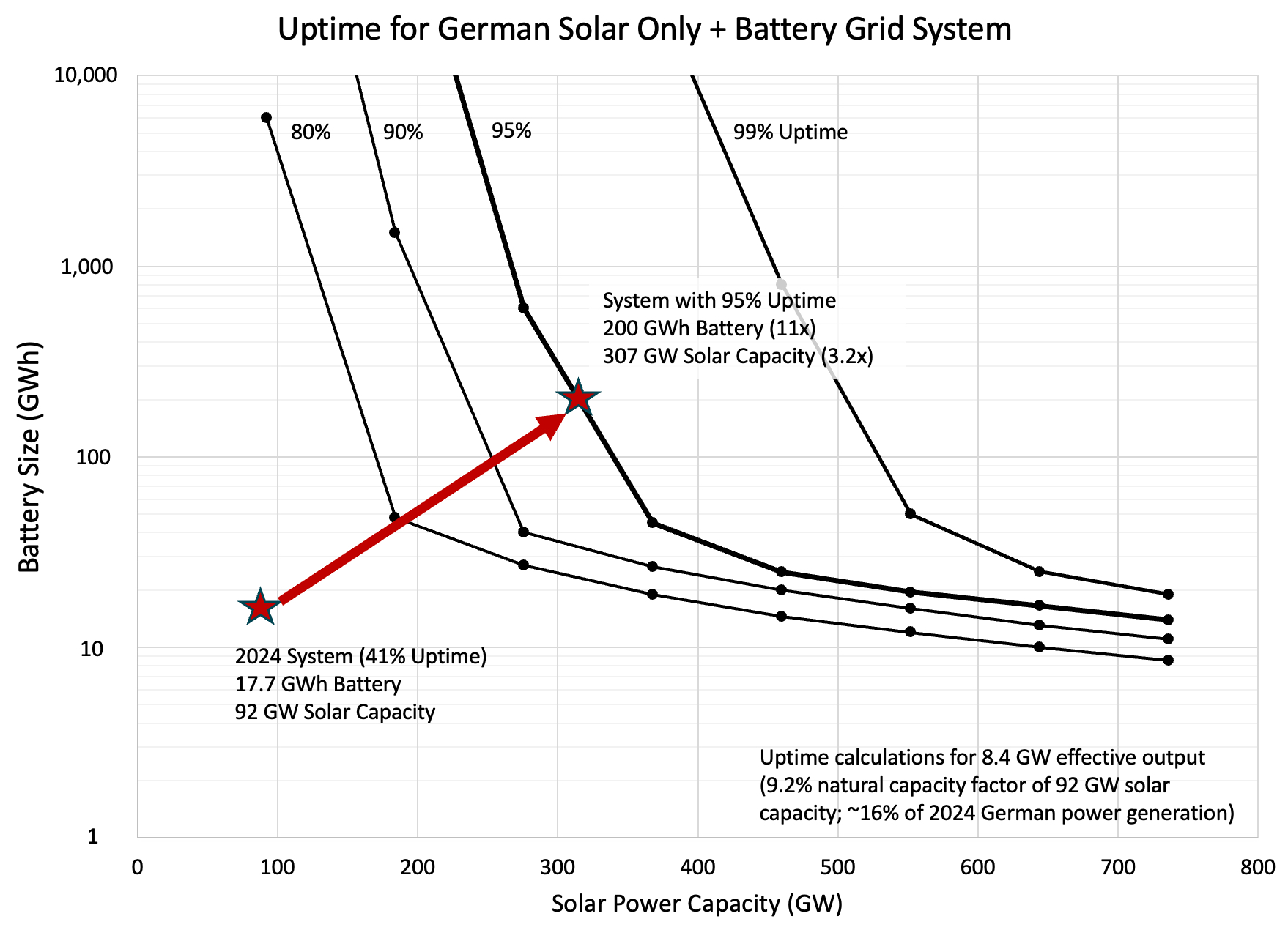
Let’s go through an example. In 2024, Germany had an average of 92 GW in solar generation capacity. Solar’s natural capacity factor in Germany was 9.2% for 2024, so the average power was about 8.4 GW. But that power is intermittent. How would the solar-only system have to change to provide that 8.4 GW with a steady 95% uptime?
Germany's solar's uptime (exceeding the 9.2% capacity factor) without a battery was 31%. To capture enough power for a full day, as a minimum about 1/31% = 3.2x overbuilding in generation is needed. As you can see in the graph below, with less overbuilding than this threshold, the battery requirement explodes and pushes to more seasonal storage to capture the extra sunlight from sunny summer to power the dark winter. That is impractical and expensive. Once Germany overbuilds solar capacity by 3.2x (to 307 GW for the 8.4 GW power “guarantee”), it needs about 200 GWh, or about 11x more than it has today, in battery firming to 95% uptime. And that only represents ~16% of its electricity needs.
LCOE assumes the electricity market is only about generating electricity. It is not a metric that cares about customers receiving it at a specific time and place. As per Robert Bryce 💡: electricity is a service.
Of course, even Germans will not overbuild by that much; they will rely on other sources. However, when you overbuild intermittent sources to make them more reliable, the system costs keep going up, up and away!
LCOE: Brought to you by the Net-Zero Industrial Complex.
I don’t quite see how you take the solar availability factor of 31% and just divide it into the required solar generation. Presumably, when it’s cloudy (or nighttime) in one part of Germany it’s more likely to be cloudy elsewhere. Am I missing something?