

In Wind's Wake

The Wright Brothers did their weather homework: they chose the beach of Kitty Hawk, NC, for its relatively constant and reliable wind. After years of experimentation and tweaking designs of their kite, they added an engine to, what Wilbur Wright called: “Render us independent of wind.”
Once they had their successful first flight there on December 17, 1903, they moved back to Dayton, Ohio, where the wind was unreliable - much like everywhere else on the planet. But by then it did not matter anymore - their machine could fly without wind.
The Dutch regulator uses a bid-low-charge-more-later strategy that is, to say the least, disingenuous. Overpromise so your wind development plan is accepted by taxpayers / voters; underdeliver on electricity output while you leave it to future leaders to explain your mess.
If there is one other place in the world they could have tried beyond Kitty Hawk, northwestern Europe would have made a good candidate.
I have been very critical of northwestern European solar lately, because the sun’s poor work ethic there makes it an expensive candidate for electricity generation. If you are a European utility trying to make money from ratepayers through overbuilding, “baseload” solar is your strategy to riches. Like solar power, wind power does not work most of the time. But the wind is there quite a bit more than the sun, especially over the North Sea.
Unreliable Wind
In Figure 1 below, we compare the electrical generational capabilities of onshore (left) and offshore (right) wind power in Germany through 2024, using a 15-minute dataset. The graphs shows output for a “1 GW” wind power system. Notice how 1 GW is never achieved for any of the 15-minute intervals throughout the year. On average for the year, the power output shows a natural capacity factor of 20% and 32%, respectively, for onshore and offshore wind.
What is critical for these systems is how they do through wind droughts. If we look carefully at both plots, you see that wind is somewhat seasonal. Most wind droughts happen around the spring and summer, while some happen in the fall and winter. A quick analysis of 2-day moving averages (dotted lines) showed 15 periods of underperformance (below 20% of 1 GW) for onshore wind in fall/winter, while offshore wind shows about 9 such periods. So, while being at sea helps, it is not a silver bullet to make wind power reliable.
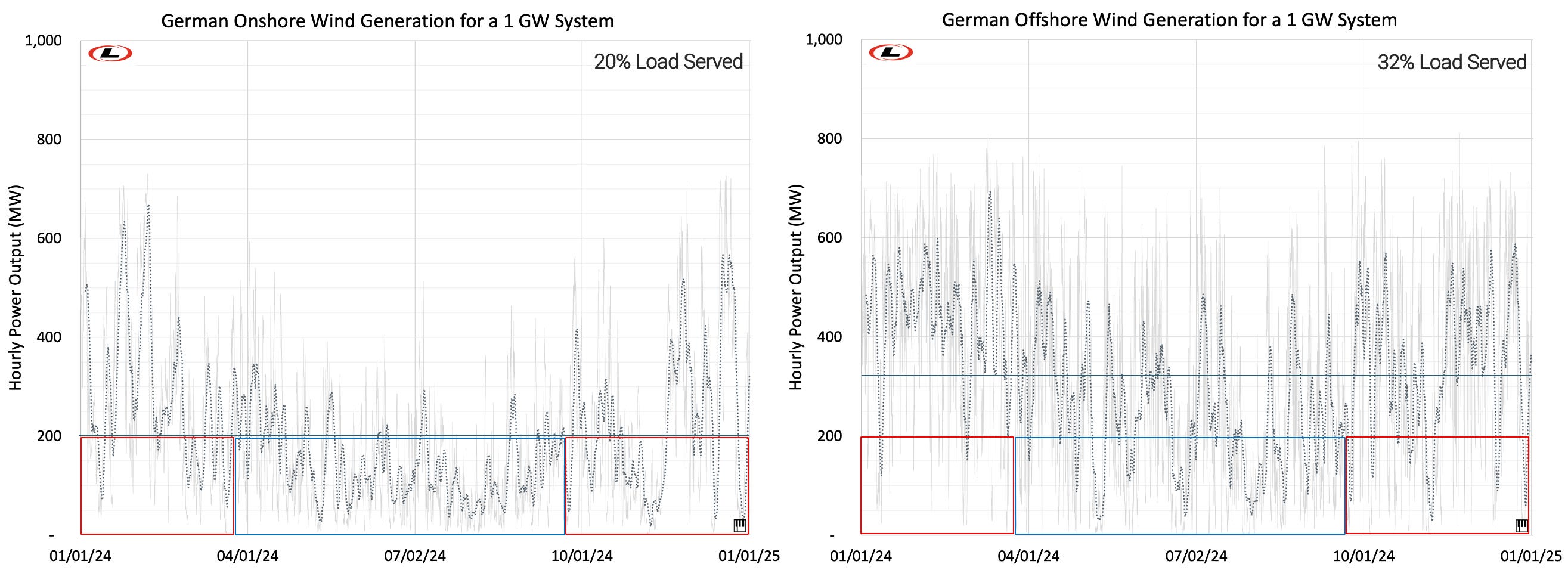
Figure 1: Measured German 2024 electricity output for onshore (top) and offshore (bottom), as normalized to a 1 GW wind power capacity
In the Shadows
But it gets worse.
When you stand between someone and the sun you put them, at least partially, in your shadow. The same happens with wind, where you can take shelter in somebody’s wake. The wake of the wind behind a modern windmill can be long and determines how much space is needed between windmills so all of them receive near-maximum power at “virgin” wind speeds. Put them too close and the power generation per windmill decreases. If you have access to a limited area, for example a permitted section in the North Sea, electricity generation is not linearly proportional to the number of windmills.
Just like when you put multiple straws in a milkshake, the production interference becomes extreme and the production per straw suffers. In wind’s case, when wake-effects start to matter the economics are subjected to diminishing returns.
On land, these wake effects are evident. You slow down wind when you put more objects in its way. Figure 2 below shows that wind speeds near Schiphol, Amsterdam’s airport, have been decreasing for the last few decades due to higher-intensity building. Wind speeds across the North Sea are higher and have been more steady to date.
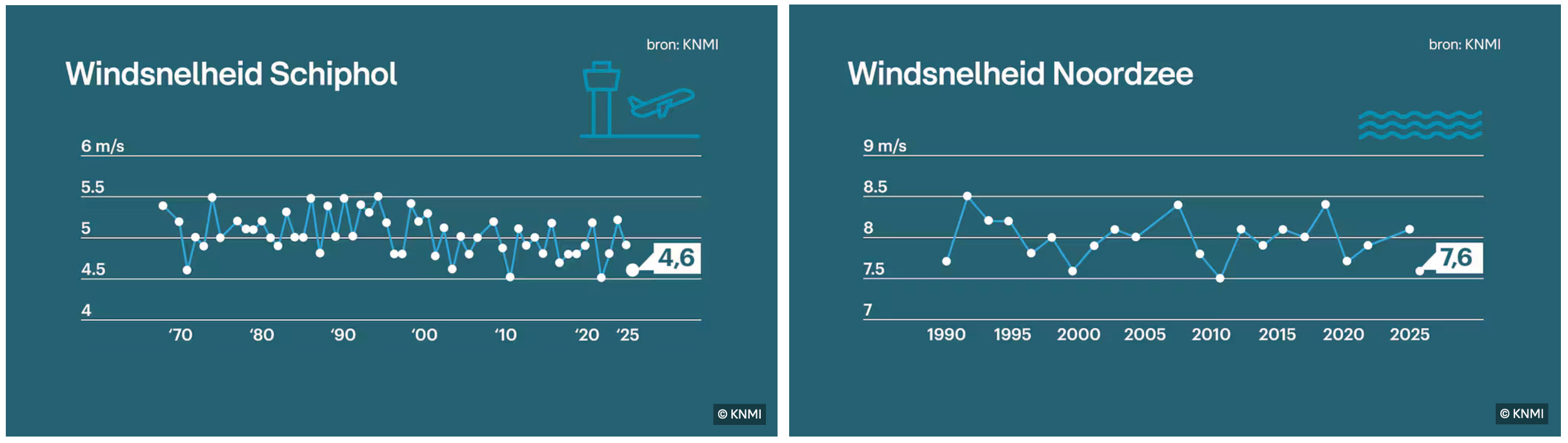
Figure 2: Measured wind speeds at Schiphol AMS airport (left) and at the North Sea (right). Objects are reducing wind speeds over land. Wind speeds are higher and have remained more steady over sea.
But that may be about to change. Current North Sea wind power harvests virgin wind speeds at a power density of about 7 Watts per square meter (W/m2), but Dutch regulators have been pushing for more than 10 W/m2 in generation capacity. While you can install more wind power per unit of surface area, diminishing returns will manifest themselves as a lower capacity factor.
These newspapers all refer to a technical paper published in November 2025 by Ferreira, Larsen and Sørensen. Its central premise is to define a single dimensionless parameter, Wind Farm Wind Factor, to address inefficiencies in power generation:
The Wind Farm Wind Factor is defined as the ratio of the turbine rated wind speed to the product of the unperturbed mean wind speed at hub height and the velocity reduction factor, which accounts for the impact of wind farm layout and wake effects.
A Wind Farm Wind Factor of 1 by definition harvests virgin wind speeds, and which is associated with a natural capacity factor of 60% or more. Most commercial wind parks in the North Sea, however, map somewhere between 1.2 - 1.6, where the capacity factor has been reduced to 30 - 50%.
The paper essentially shames policymakers and their assumption that wind power can increase linearly with the number of windmills, and that the wind wake effects are non-existent.
Two quotes from the paper (emphasis ours) highlight the wind policy - physical reality mismatch:
In the Dutch case, national planning assumptions for offshore wind have shifted from 10 MW/km2 and a capacity factor of 51.5% to the latest government plan targeting 10.5 MW/km2 and even higher capacity factors —ranging from 51% to 56%. However, these scenarios are not only internally inconsistent with physical wake losses at higher densities, but they also depart from observed trends in operational wind farms.
When we began this work over 2 years ago, the Dutch targets were already overly optimistic; since then, policy assumptions have only drifted further from physical reality, amplifying the risks of overpromise and underdelivery.
Figure 3 shows how wind’s natural capacity factor effectively decreases with wind power density. Dutch policy (Dutch flag at the middle/top) assumes a power density of about 10 - 10.5 W/m2 (wind farm wind factor of 1.4-1.5), while it expects a natural capacity factor of 52%. Instead, the theoretical limit for that windmill density is only 35%.
Dutch policy is therefore telling Dutch ratepayers wind can do about 50% more than what it truly can do. While the Dutch regulator is the most overly optimistic about wind’s abilities, the graph shows that most other government policy is unrealistic on the upside.
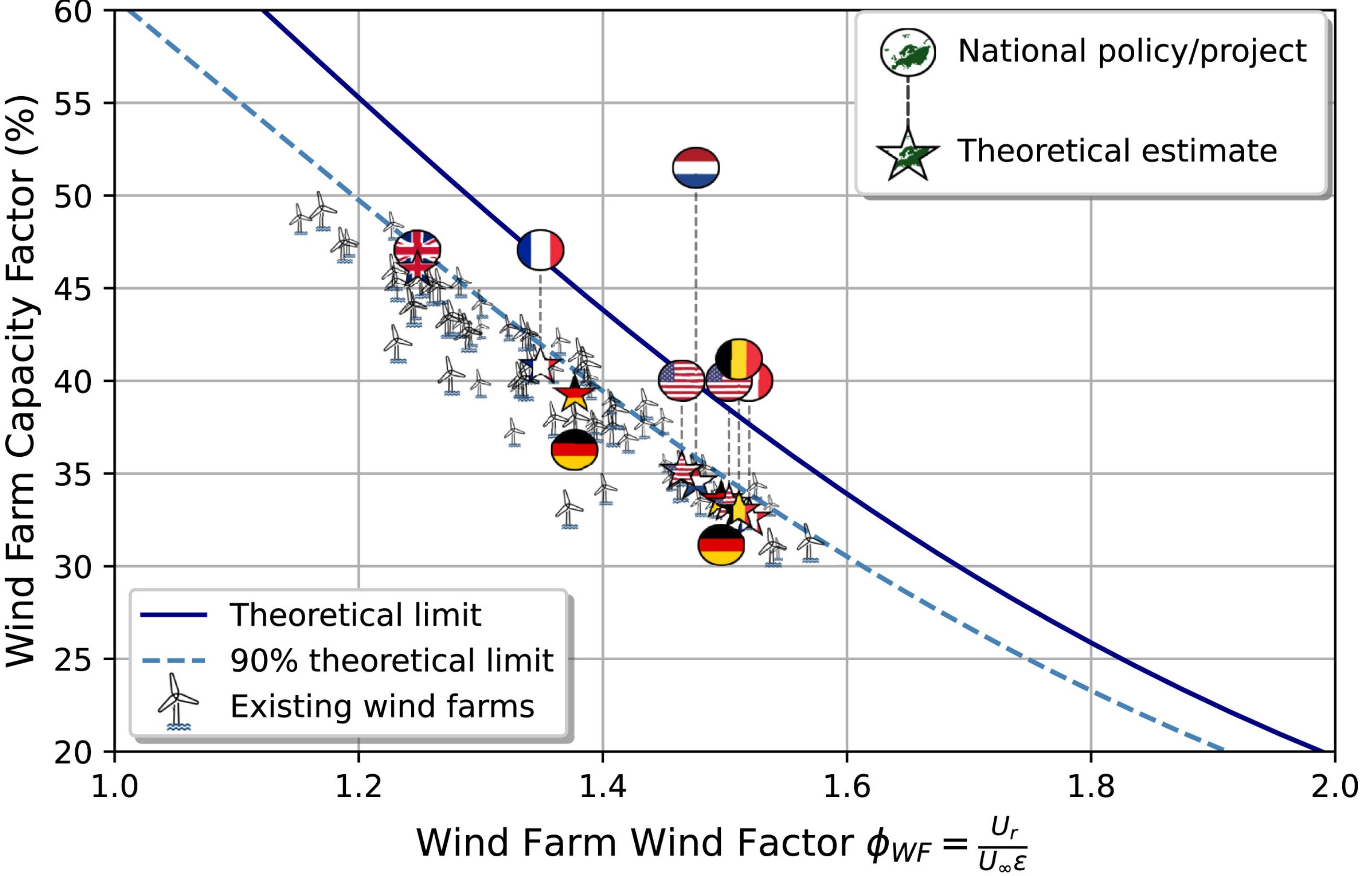
Figure 3: Wind farm natural capacity factor vs windmill density (graph taken from Ferreira, Larsen and Sørensen)
Overbuilding Wind Farm Density
Wind will always be a diluted power source that requires hundreds of times more space than fossil fuel power plants and thousands of times more space than nuclear power.
Lying about wind’s capabilities has consequences. Not just for the power you can generate per unit of surface area, but also for the cost to generate that power. Less power generated for a given lifetime of a wind turbine means that mining, building and installation cost have to be earned back over fewer megawatt-hours (MWh) generated. It also means the technology will not avoid as much of the CO2 emissions as promised, because wind’s emissions are mostly associated with mining, building and installing, all of which increase when windmill density increases.
Figure 4 below is the money graph of the paper by Ferreira, Laursen and Sørensen. They plot both the Levelized Cost of Electricity (LCOE) and the associated wind capacity factor against their Wind Farm Wind Factor.
Unobstructed North Sea wind using a high and modern wind turbine (wind farm wind factor around 1.0) may get to a natural capacity factor of 60% and may have an LCOE as low as €70/ MWh. This cost estimate aligns with the low end of LCOEs for offshore wind as per Lazard, the main keeper of LCOE estimates.
If we look at the position of the Dutch flag, which indicates policy, the Dutch government expects a 52% natural capacity factor at $77/MWh, but with over-building of wind capacity will only get 35% at a cost of €112/ MWh.
The authors derive a simple equation to accompany the graphic, showing LCOE is inversely proportional to the natural capacity factor (CF) around a cost point of €80/ MWh at a natural capacity factor of 50%:
LCOE (@ actual 𝐶𝐹) = €80×((CF of 50%) / (actual 𝐶𝐹)) (in €/MWh)
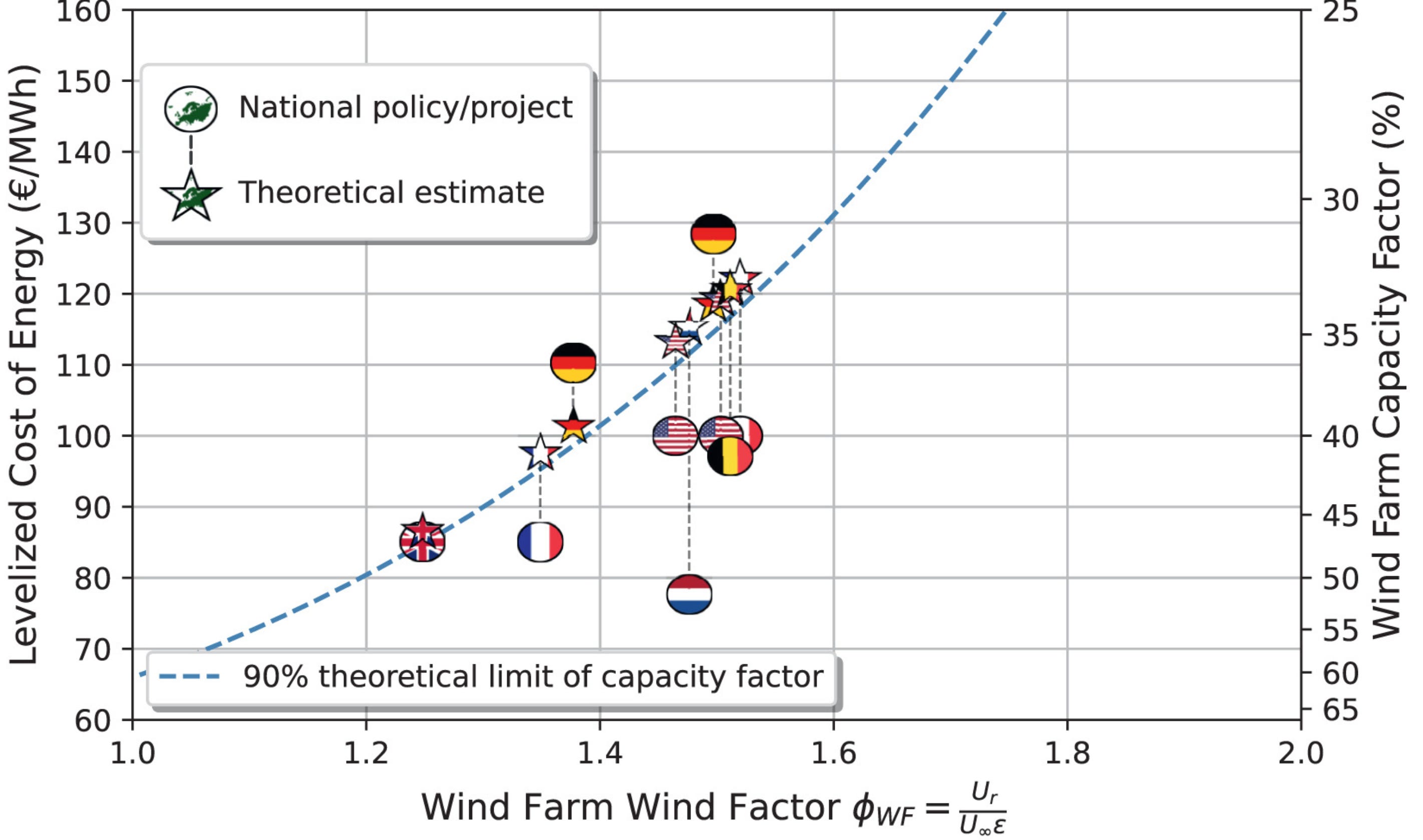
Figure 4: LCOE correction to account for wind farm density and associated wake effects. For the Dutch regulator, offshore wind LCOE is not €77/MWh, but more like €112/MWh.
Overbuilding Wind Capacity
And it does not stop there. In its roadmap to clean power, the Dutch Ministry of Infrastructure and Water Management states 21 GW of offshore wind power will be needed by 2030.
Overbuilding toward “baseload” wind makes the LCOE higher still. Figure 5 below shows overbuilding to achieve 90% baseload wind power with battery backup costs almost twice as much as unfirmed wind. Even as the Dutch work up to higher load served, additional wind power will cost more as more of that power becomes curtailed.
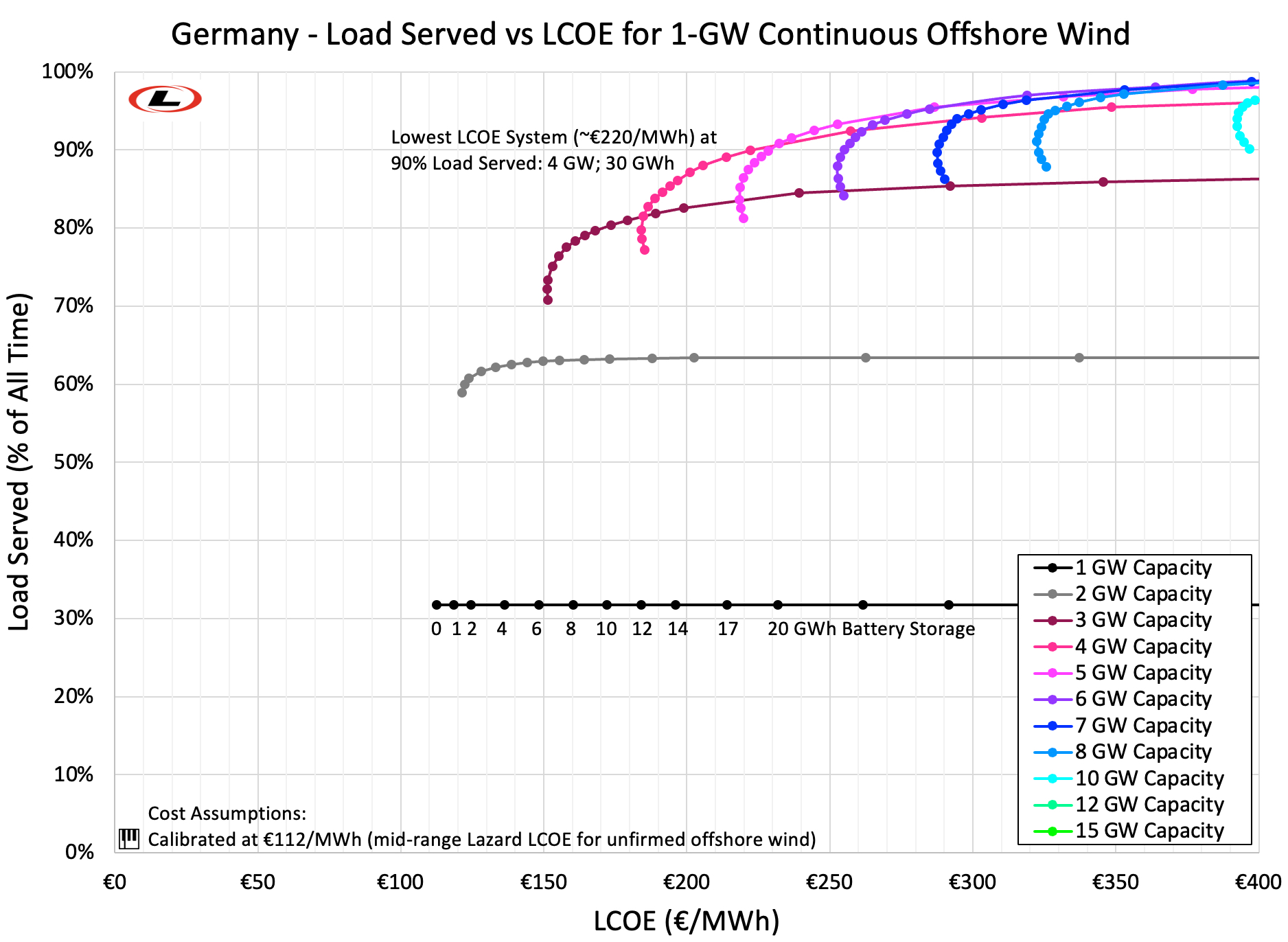
Figure 5: LCOE as a function of load served for North Sea wind power (bottom)
Overselling Wind
While the Dutch Government is telling rate payers their wind power will cost €77/MWh, they deliver it at €112/MWh, and even more in the future. This is a bid-low-charge-more-later sales strategy that is, to say the least, disingenuous.
Overpromise so your proposal is accepted by taxpayers/voters; underdeliver on electricity output while you leave future leaders to explain your mess.
Reliability is also not helped by combining it with solar, which is very low for most of that period. We have renewables to thank for deepening the German language with its own word for a period of low wind and low sun: dunkelflaute. Literally a dark, dead calm.
The Wright Brothers were smart enough to engineer around it. Will these northwestern Europeans be as smart?
Conclusions
In the best place for wind power on earth, periods without wind happen onshore and offshore. These periods happen during all seasons (albeit mostly around summer), and these periods sometimes happen when the sun does not shine (Germans have a name for this - a “Dunkelflaute”)
European governments / regulators oversell wind’s capabilities in two ways. First, by assuming wind power density can increase without diminishing returns associated with the physics of wind’s wake. Second, by overbuilding wind capacity, leading to higher curtailment, higher LCOE and lower CO2 emission avoidance than promised.
When will Greenwishing be held accountable?
Despite all the evidence of the lack of reliability and increased costs the green grifters have a managed to scheme the system for decades and decades. When will this insanity stop? It’s like whack a mole trying to fight the entire green is cheaper and better for the environment agenda.