

German "Baseload" Solar

Energy Bad Boys Isaac Orr and Mitch Rolling have been venturing into the “baseload” solar cost and the impact of pricing out intermittency.
In a recent Substack, they evaluate the cost of a solar + battery solution to create different levels of reliability in the sunny ERCOT grid in Texas. Spoiler alert! They find that 100% reliable solar backed by batteries is 16x more expensive than new combined-cycle natural gas.
If it is that bad in about the sunniest place to generate solar power, how bad is it in places where the sun is absent most of the time, like Germany?
The natural capacity factor for German solar throughout the year 2024 was 9.2%. That’s about half of a 32-hour European work week. During some winter months the natural capacity factor was below 2%. Compensating for this lazy work attitude requires significant overbuilding of both components to get to reasonable levels of reliability.
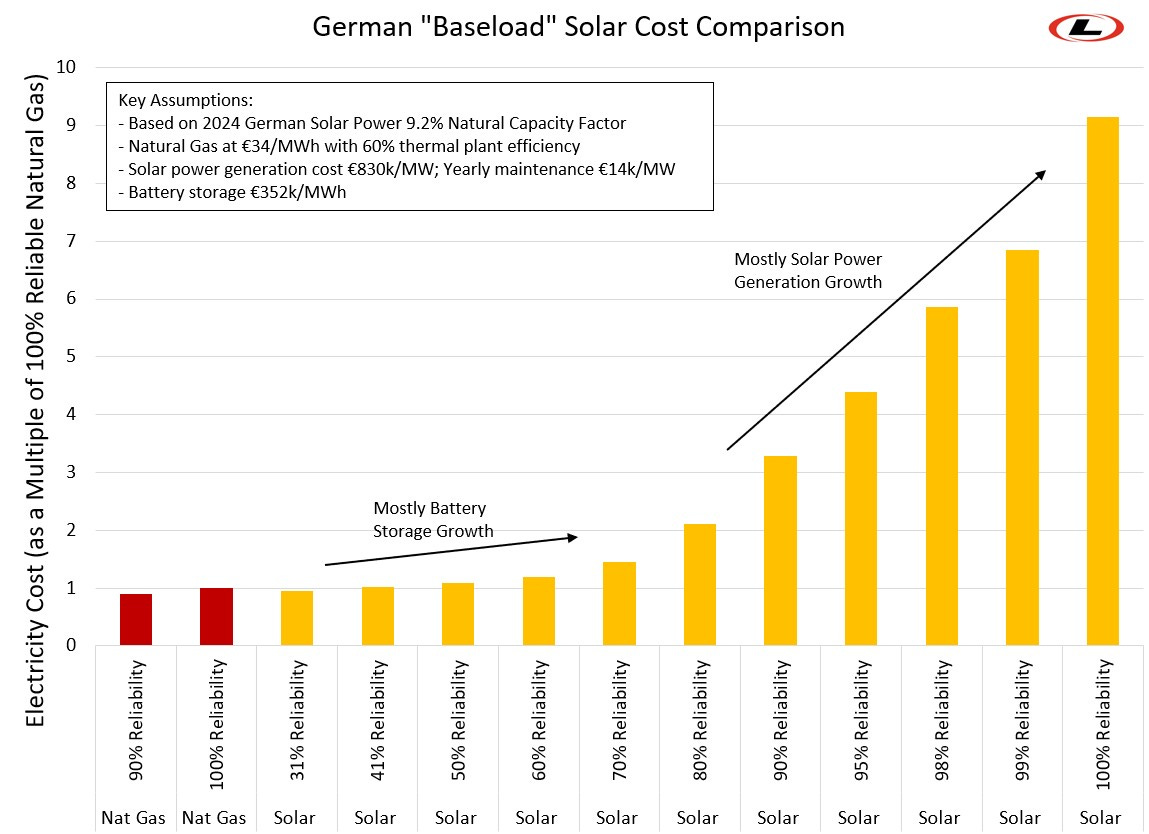
While the sun may not shine effectively at full capacity, there is light to charge solar panels for about 31% of the time – the base reliability case. Germany’s current ~18 GWh of batteries, assuming they are only backing solar, have pushed reliability to 41%. The most cost-effective way to further increase that is generally first through further battery expansion, while beyond 80% reliability it requires overbuilding of solar power capacity.
On the right-hand side of the plot below, making the current solar capacity 100% reliable to work at its average 9.2% capacity factor, requires overbuilding that capacity by a factor of 8x. Natural gas is also more expensive in Europe, so the ratio that I am presenting in the plot below is not as lopsided as in Texas.
Still, generating “reliable solar” power in Germany is many times more expensive than using natural gas - 1 reliable worker is cheaper than 8 unreliable ones.
🤪 crazy