

Extra Carbon Credit

One of the more bizarre features of the American education system is extra credit. “Extra” is magical in the sense that it counts toward a numerator of obtained credits, but it does not count in the denominator of all possible credits.
This chicken has come home to roost. You know I am not one who thinks carbon is a threat to the planet - in fact, quite the opposite. But if you are among the people who think this element needs to be taxed in order to minimize its use, how can you support the waste associated with extra carbon credit?
A voluntary carbon market currently assigns a carbon credit of about $50 per ton of CO2 avoided. But avoidance credits are massively higher for many things, mostly associated with so-called renewable energy, for example, as David Blackmon recently reported, for offshore wind.
As U.S. Department of Energy (DOE) hunts for budget savings, it should look at residential solar photovoltaic (PV) systems. The Residential Clean Energy Credit equals 30% of the cost of new “clean energy” property for homes. For a typical solar installation of $27,500, that’s $8,250.
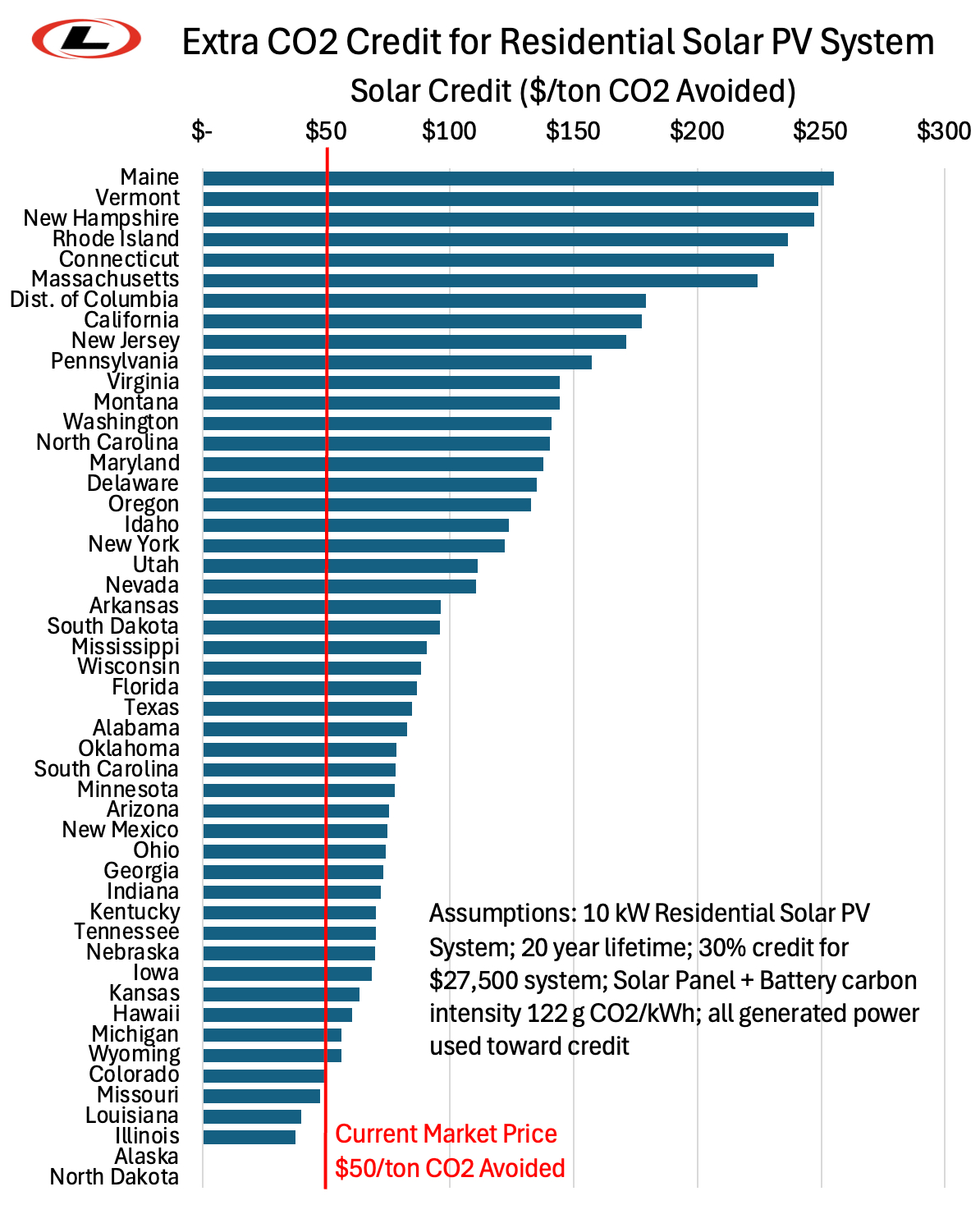
In the graph below, I did an analysis to determine how much buyers get paid to avoid CO2 emissions. I took the natural solar power capacity factor by US state to calculate how much sunshine they can catch over their lifetime. Then, I calculated the offset in CO2 by subtracting each state’s grid CO2 intensity per kWh from the solar/battery system intensity. Note that I included a battery in the system to fully claim all generated solar power toward the credit.
In mid-western states, where the grid carbon footprint is somewhat higher than the rest of the country and where sunshine is relatively abundant, the credit is closer to market value. But in places where the sun does not shine a much, and where the grid carbon intensity is already lower, this government program wastes dollars. It is another funds transfer from taxpayers in the US heartland to homeowners on the two left coasts.
Extra credit suggests you are getting something for nothing. But there is no free lunch. On the other side of credits, someone pays. That someone is likely your child or your kid’s child.
But maybe they won’t care, because they will all receive A++++s on their report cards and they will all think they’re above average.
More examples of why this country is 37 trillion dollars in the hole.