Energy Density and Population Density

Some countries don’t have enough land to rely on renewables.
When you drive around most areas in our country, have you ever wondered why you see so many more wind and solar farms than oil wells or nuclear power plants? Nuclear power, coal, oil and gas provide Americans with 87% of all their primary energy consumption, so shouldn’t we see a lot more of it?
The reason is power density. Dense power only takes up a small space.
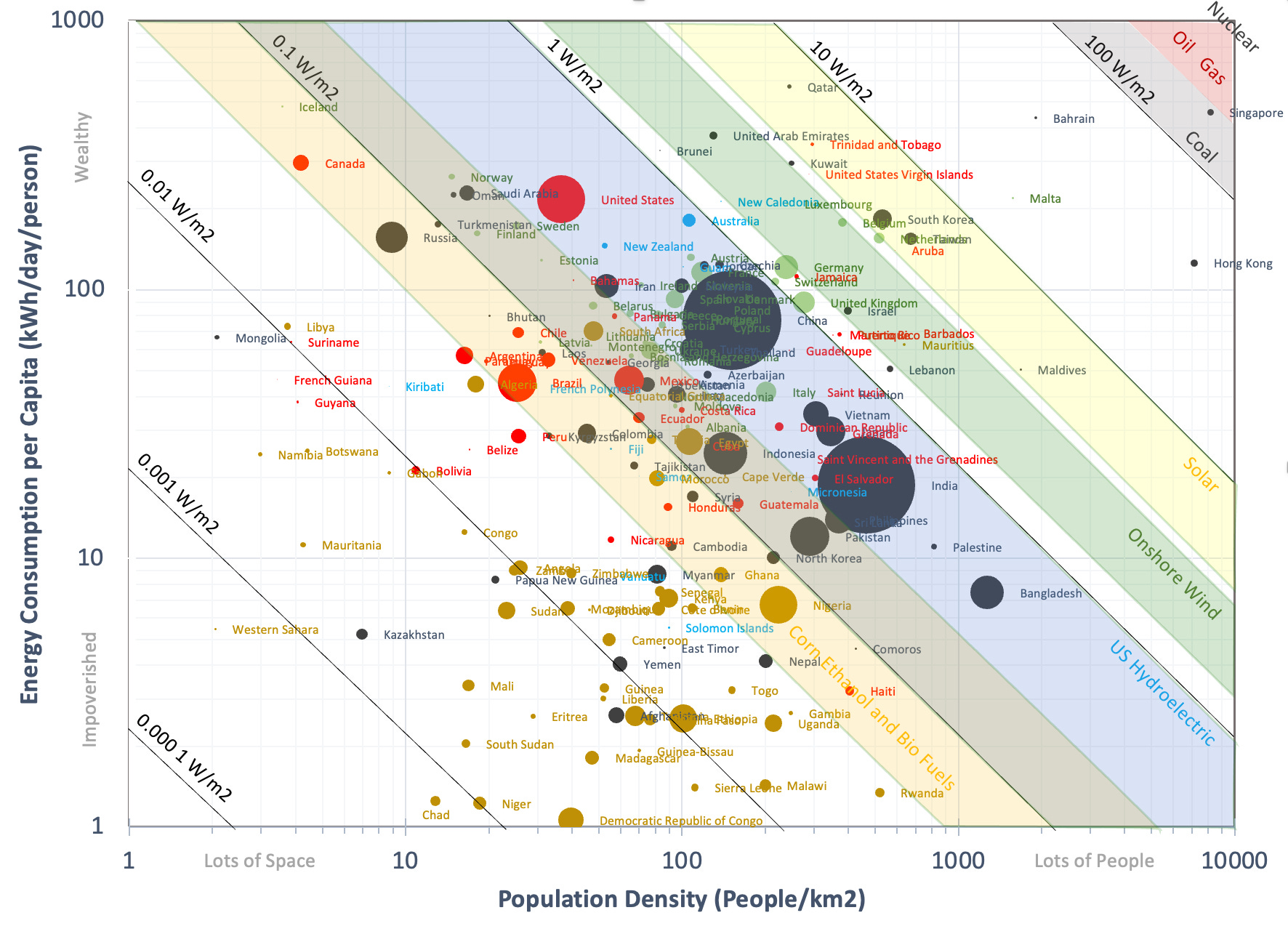
The plot below has some of the highest information density of graphs and was initially devised by the genius of David MacKay. It plots, on a log-log scale, per capita primary energy consumption versus population density. When you plot these variables against each other your diagonals become power densities, moving from 0.0001 W/m2 in the left bottom corner to almost 1,000 W/m2 on the top right.
The datapoints are the aggregated primary power needed by the people in these countries. Rich countries with high energy needs map to the top; poor countries map to the bottom. Highly populated city states and countries with high population densities map to the right; countries with lots of open space to the left.
I added bands with the general power density of various energy sources – dilute sources on the left, dense sources on the right. In a simplification, these bands do incorporate intermittency in the form of a reduced effective power density.
You can see that Singapore (needs 200 W/m2) can never be self-sufficient on solar (generates ~8 W/m2); the Netherlands does not have enough space to run 100% on onshore wind; and we would need the land of 5x the United States to power all Americans exclusively with corn ethanol. Poor countries could use these sources, but as soon as their people get richer and their energy use moves upward in this plot, various renewable sources become insufficient for their use.
Fossil and nuclear can create dependencies on foreign countries if countries do not have or want to develop resources in their own backyard. But if you have a high population density and high per capita energy use, you may run out of land when you plaster your countryside with renewables.